AI Governance
From AI Automation to Human-Centred Transformation: The Workforce Pillar of STEWARD-AI™
Dr. Rajiv Yadav, DBA · STEWARD-AI series · 4 min read
Workforce pillar of STEWARD-AI™: Skills Readiness, Human–AI Collaboration, Work Redesign and Culture & Change.
The W – Workforce pillar is particularly important within STEWARD-AI™ because AI transformation is not merely about technology adoption. It fundamentally changes how people work, how organisations develop capabilities, how decisions are made, and how humans collaborate with intelligent systems.
For Boards, the central question is no longer simply, “How many jobs will AI replace?” It is “How do we prepare our people, redesign work, and build an organisation capable of thriving alongside AI?”
The Workforce pillar addresses four interconnected dimensions: Skills Readiness, Human–AI Collaboration, Work Redesign, and Culture & Change.
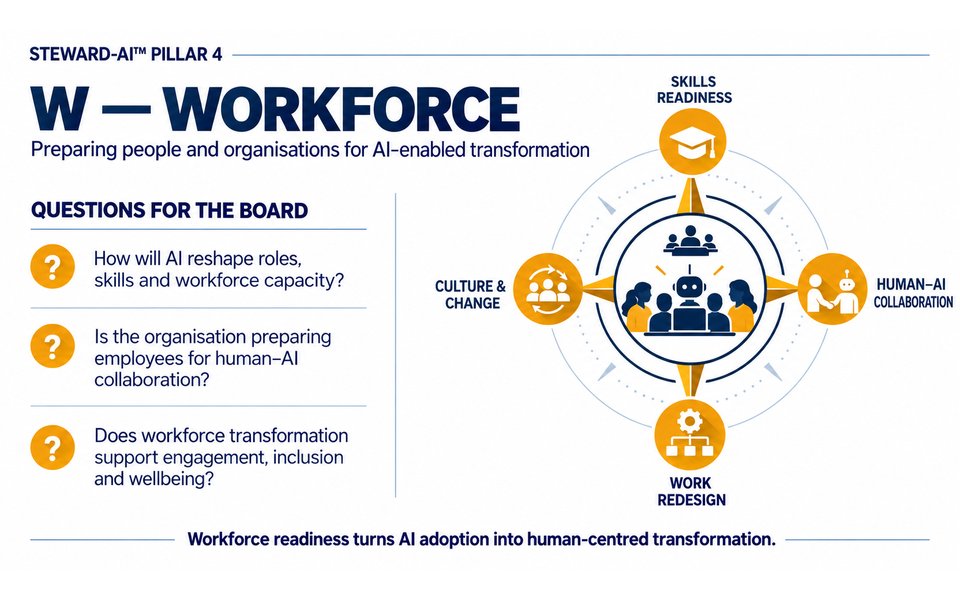
STEWARD-AI™ Pillar 4 — W: Workforce
Preparing people and organisations for AI-enabled transformation.
1. Skills Readiness
AI adoption requires organisations to rethink the capabilities their employees and leaders will need.
Traditional workforce planning has focused on headcount, recruitment, productivity and succession. AI introduces an additional challenge: existing skills may become less relevant, while entirely new capabilities emerge.
Boards should ensure that management has a forward-looking workforce strategy aligned with the organisation's AI ambitions.
This includes assessing current capabilities, identifying future skills gaps, developing reskilling and upskilling programmes, and preparing leaders to manage AI-enabled teams.
Importantly, skills readiness is not limited to technical expertise. Critical thinking, judgement, adaptability, ethical awareness and the ability to work effectively with AI will become increasingly valuable.
Key Board question: Is our organisation investing sufficiently in the skills and capabilities required for an AI-enabled future?
2. Human–AI Collaboration
The second sub-pillar examines how humans and AI systems work together to improve organisational performance.
AI can analyse large volumes of information, identify patterns, automate routine activities and support decision-making. However, human judgement, empathy, contextual understanding and accountability remain essential, particularly for consequential decisions.
Boards should assess whether management is designing human–AI collaboration deliberately rather than introducing AI tools without clearly defined responsibilities.
This includes establishing where AI can support decisions, where human oversight is required, and how employees can challenge or override AI-generated recommendations.
For example, in banking, AI may support credit assessment, fraud detection and customer engagement. However, important decisions must remain subject to appropriate human accountability and governance.
Key Board question: Are we creating an effective partnership between human judgement and AI capabilities while preserving accountability?
3. Work Redesign
AI transformation is not simply about automating existing processes. It creates opportunities to fundamentally redesign how work is organised and delivered.
Boards should encourage management to examine how AI changes roles, workflows, decision rights, organisational structures and productivity.
Some activities may become automated, others may be augmented, and entirely new responsibilities may emerge.
The challenge is to ensure that organisations do not merely introduce AI into inefficient processes but use the opportunity to rethink operating models and create sustainable value.
Work redesign must also consider employee engagement, inclusion, wellbeing and the consequences of workforce displacement.
Boards should expect management to evaluate both productivity improvements and the human implications of transformation.
Key Board question: Is AI enabling meaningful work redesign and productivity improvement while supporting employee wellbeing and inclusion?
4. Culture & Change
Successful AI transformation depends as much on organisational culture as on technological capability.
Employees may welcome AI as an opportunity to improve productivity and develop new skills. Others may experience uncertainty about job security, changing responsibilities or their ability to adapt.
Boards should ensure that management addresses these concerns through transparent communication, employee participation, leadership commitment and structured change management.
A culture of continuous learning, experimentation and responsible innovation will be essential.
Organisations must also encourage employees to question AI-generated outcomes, report concerns and exercise independent judgement without fear of negative consequences.
The Board's role is to oversee whether the organisation is developing the leadership behaviours, values and cultural readiness necessary for sustainable AI adoption.
Key Board question: Is our organisational culture enabling employees to embrace AI responsibly, confidently and inclusively?
Distinguishing Workforce from the other STEWARD-AI pillars
An important distinction is that Strategy focuses on enterprise value, Trust on stakeholder confidence, Ethics on responsible outcomes, and Workforce on organisational and human readiness.
For example, consider a bank introducing AI-powered customer service and credit decision support.
Strategy: Will AI improve competitiveness, customer experience and long-term value?
Trust: Can customers and employees rely on AI-enabled outcomes?
Ethics: Are decisions fair, responsible and respectful of human rights?
Workforce: Are employees equipped to work alongside AI, and have roles, processes and capabilities been redesigned appropriately?
These questions demonstrate why Workforce deserves its own governance pillar rather than being treated simply as an HR initiative.
Three fundamental questions for the Board
Your slide captures the essence of the Workforce pillar through three questions:
How will AI reshape roles, skills and workforce capacity?
Is the organisation preparing employees for human–AI collaboration?
Does workforce transformation support engagement, inclusion and wellbeing?
Together, these questions move the Board discussion beyond automation and headcount reduction toward human-centred organisational transformation.
About the author: Dr. Rajiv Yadav is an international Board Strategy & Governance Advisor and Global Thought Leader in Board Stewardship, with more than 35 years of boardroom and executive leadership experience across four continents. He is the creator of STEWARD-AI™.