AI Governance
From AI Ambition to Sustainable Value: The Strategy Pillar of STEWARD-AI
Dr. Rajiv Yadav, DBA · STEWARD-AI series · 5 min read
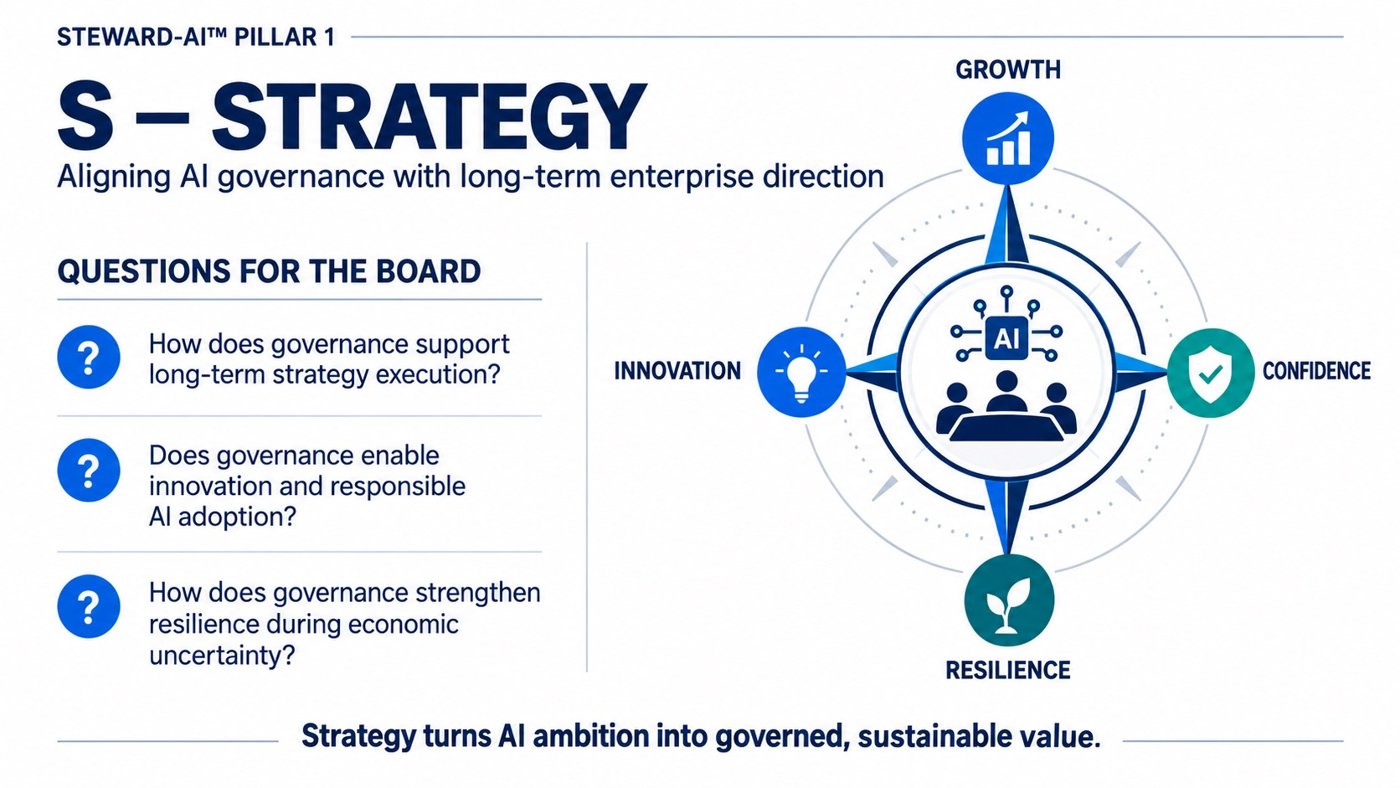
Strategy pillar of STEWARD-AI™: connecting AI ambition with enterprise purpose through Growth, Confidence, Resilience and Innovation.
Artificial Intelligence is reshaping how organisations compete, operate and create value. It can improve customer experiences, increase productivity, strengthen decision-making and enable entirely new business models. Yet the speed of AI adoption also creates a danger: organisations may pursue disconnected initiatives without a clear view of how those initiatives support long-term enterprise direction.
For Boards, the central question is therefore not simply, “Are we investing in AI?” It is, “Are our AI investments aligned with the organisation’s strategy, values and long-term objectives?”
This is the focus of the Strategy pillar within STEWARD-AI™, a Boardroom Framework for Responsible AI Leadership. The Strategy pillar helps Boards connect AI ambition with enterprise purpose and ensure that technology investments contribute to governed, sustainable value.
At its core, the pillar examines four interconnected dimensions: Growth, Confidence, Resilience and Innovation.
Strategy Begins with Enterprise Direction
AI initiatives often begin in individual business units or technology teams. A customer-service function may experiment with a virtual assistant, an operations team may automate a process, or a risk function may deploy predictive analytics. Each initiative may appear valuable on its own, but the Board needs a broader enterprise perspective.
Are these investments supporting the organisation’s strategic priorities? Are they addressing important customer or operational needs? Are resources being allocated to the areas of greatest potential value? Is the organisation developing capabilities that will remain relevant as technology and markets evolve?
Without strategic alignment, AI can become a collection of pilots rather than a driver of transformation. The Board’s role is to ensure that management has articulated a coherent AI ambition, connected it to business strategy and established clear measures of success.
The Strategy pillar provides a practical lens through its four sub-pillars.
1. Growth
The first sub-pillar considers how AI can support sustainable business growth.
AI may help an organisation serve customers more effectively, enter new markets, improve productivity, enhance products or develop new sources of revenue. However, growth should not be measured only by the number of AI projects launched or the amount of money invested. Boards should examine whether AI is producing meaningful business outcomes.
This requires clarity about where value is expected to come from. Is AI helping the organisation increase revenue, reduce avoidable costs or improve capital allocation? Does it strengthen customer retention or enable the business to scale more effectively? Are benefits being measured against the full cost of implementation, including data, infrastructure, skills, governance and ongoing monitoring?
Boards should also consider whether governance structures are aligned with growth objectives. Effective governance should help management make better investment choices, scale successful initiatives and stop projects that no longer support the strategy.
The objective is not growth at any cost. It is growth that is responsible, measurable and sustainable.
2. Confidence
The second sub-pillar focuses on confidence among investors, customers, employees, regulators and other stakeholders.
AI can create considerable value, but uncertainty about how it is governed may weaken stakeholder trust. Investors may question whether risks are understood. Customers may be concerned about privacy, fairness or transparency. Employees may be uncertain about how AI will affect their roles. Regulators may expect evidence of accountability and effective oversight.
Strong governance gives stakeholders confidence that the organisation is approaching AI with discipline. It demonstrates that responsibilities are clear, material risks are considered and important decisions are subject to appropriate oversight.
For Boards, confidence also depends on the quality of information they receive. Directors need reporting that explains not only what an AI system does, but why it matters, what assumptions it relies upon, how performance is measured and what management will do if outcomes differ from expectations.
Good governance may also improve investor confidence and access to capital by showing that the organisation can pursue innovation without losing sight of accountability, risk or long-term value.
3. Resilience
The third sub-pillar considers whether AI strengthens or weakens organisational resilience.
AI systems may become embedded in critical processes, customer interactions and management decisions. This can create efficiency, but it may also introduce dependencies and new points of failure. Boards must understand how the organisation will respond if an AI system produces unreliable results, becomes unavailable, is compromised or no longer meets regulatory expectations.
Resilience therefore requires more than technical recovery arrangements. It includes clear accountability, effective escalation, human oversight, alternative processes and the capacity to adapt when economic or business conditions change.
During periods of uncertainty, organisations may accelerate automation to reduce costs or improve efficiency. The Board should ensure that short-term pressure does not lead to poorly governed deployment or undermine capabilities needed for long-term success.
Strategic resilience means using AI to strengthen the organisation while retaining the judgement, controls and operational flexibility required to withstand disruption.
4. Innovation
The fourth sub-pillar addresses innovation and responsible AI adoption.
Boards should encourage management to explore how AI can improve competitiveness and create new value. Excessive caution can cause organisations to miss important opportunities. At the same time, pursuing innovation without appropriate governance can create financial, ethical, operational and reputational consequences.
The goal is not to choose between innovation and governance. Effective governance should enable responsible innovation.
This means providing clear boundaries within which teams can experiment, learn and scale. It also means applying governance in proportion to the significance and risk of each use case. A low-impact internal productivity tool should not necessarily be governed in the same way as an AI system that influences credit, employment, healthcare or other consequential decisions.
Boards should ask whether the organisation has the data, skills, leadership and culture needed to innovate responsibly. They should also examine whether lessons from pilots are being captured and whether successful initiatives can move beyond experimentation into sustainable enterprise adoption.
Turning Strategy into Boardroom Action
The Strategy pillar encourages Boards to ask three fundamental questions:
How does governance support long-term strategy execution?
Does governance enable innovation and responsible AI adoption?
How does governance strengthen resilience during economic uncertainty?
These questions help Directors move the discussion beyond individual technologies. They connect AI with growth, stakeholder confidence, organisational resilience and innovation—the outcomes that ultimately matter to the enterprise.
The Board does not need to select algorithms or manage AI projects. Its responsibility is to ensure that the organisation has a clear direction, makes disciplined choices and remains accountable for the outcomes.
AI ambition alone does not create value. Value emerges when ambition is connected to enterprise strategy, supported by responsible governance and translated into confident action. That is the purpose of the STEWARD-AI Strategy pillar: to help Boards steer AI toward long-term, governed and sustainable value.
About the author: Dr. Rajiv Yadav is an international Board Strategy & Governance Advisor and Global Thought Leader in Board Stewardship, with more than 35 years of boardroom and executive leadership experience across four continents. He is the creator of STEWARD-AI™.