AI Governance
From AI Experiments to Sustainable Value: The Innovation Pillar of STEWARD-AI
Dr. Rajiv Yadav · STEWARD-AI series · 5 min read
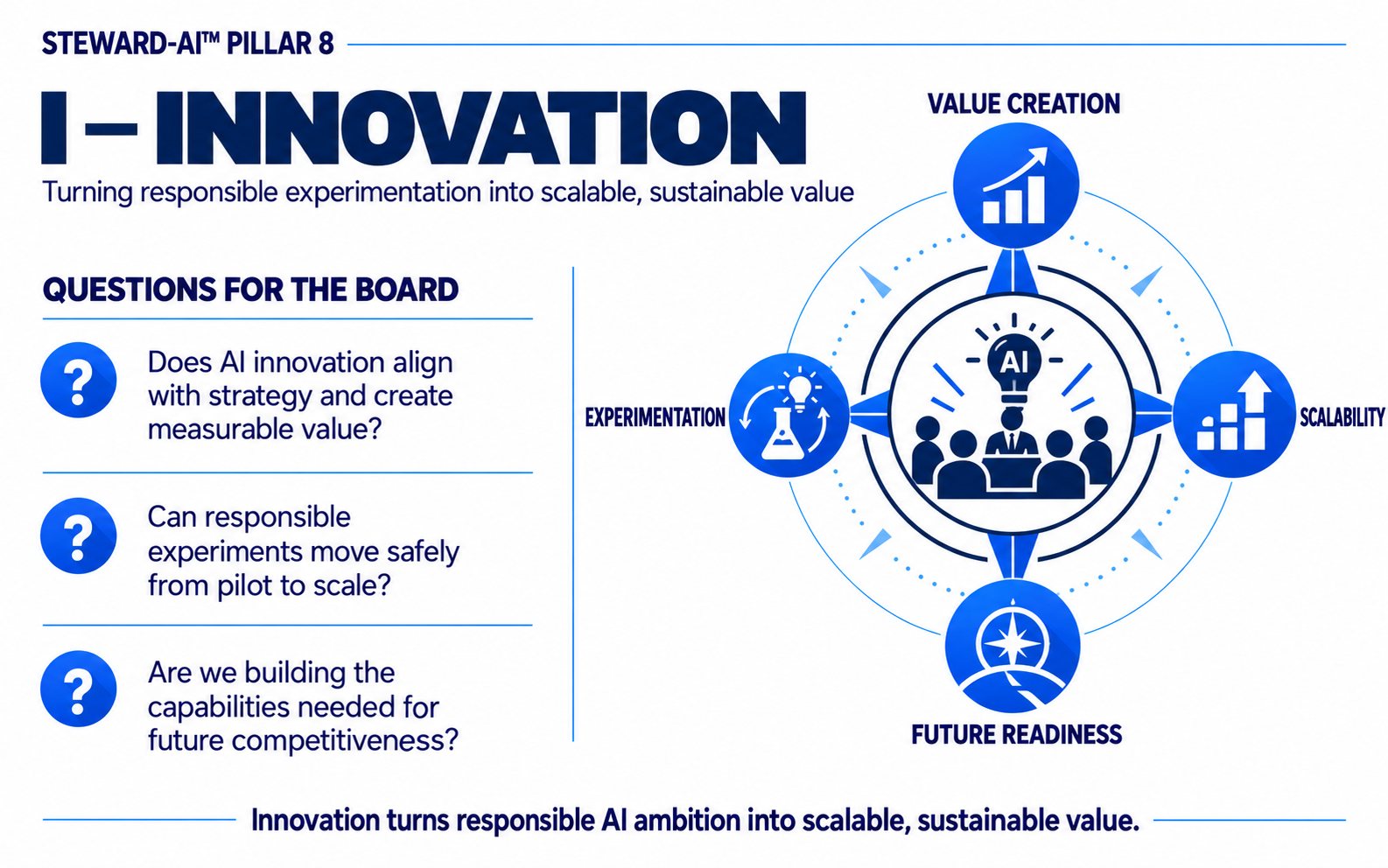
Innovation pillar of STEWARD-AI™: Experimentation, Value Creation, Scalability and Future Readiness.
Artificial intelligence can create new products, improve decisions and reshape operating models. Yet many organisations accumulate pilots without converting them into enterprise value. Individual experiments may attract attention while remaining disconnected from strategy, business ownership, workforce readiness or the controls required for responsible deployment. For Boards, the central question is whether the organisation can innovate with purpose and discipline.
The Innovation pillar of STEWARD-AI™ gives Directors a practical way to oversee this challenge. It connects experimentation with measurable value, scalable execution and future readiness. The pillar does not ask the Board to select models or manage product development. It helps the Board test whether management has created the conditions in which promising ideas can be explored responsibly, challenged objectively and expanded when the evidence supports investment.
The pillar comprises four connected dimensions: Experimentation, Value Creation, Scalability and Future Readiness. Together, they help Boards distinguish productive innovation from activity that consumes resources without producing durable outcomes.
Why Innovation Requires Board Attention
Innovation decisions affect strategy, capital allocation and risk appetite. They can also change customer relationships, employment practices and the organisation's dependence on data and technology providers. Boards therefore need a portfolio view. They should understand which AI initiatives are strategically material, what assumptions support them, how resources are being allocated and which results justify further investment.
Effective oversight gives management room to learn while establishing clear boundaries. The Board should expect defined decision rights, proportionate safeguards and evidence-based stage gates. Low-impact internal experiments may move quickly. Initiatives affecting customers, employees, regulated decisions or essential services require stronger review before testing and deployment. This graduated approach protects responsible experimentation without imposing the same process on every idea.
1. Experimentation
Experimentation allows an organisation to test assumptions before making large commitments. A well-governed experiment begins with a clear problem, an accountable business owner and a hypothesis that can be evaluated. It defines who may participate, what data may be used, which safeguards apply and what would cause the work to pause or stop. The purpose is to learn, not merely to demonstrate that a technology can produce an output.
Management should document material limitations, privacy and security checks, human oversight, expected benefits and potential effects on stakeholders. Success criteria should cover more than technical accuracy. They may include adoption, workflow improvement, reliability, user experience, cost and the incidence of harmful or unintended outcomes. Experiments that fail to meet agreed thresholds should be redesigned, concluded or archived so that resources move to stronger opportunities.
Key Board question: Do our experimentation practices encourage learning while maintaining appropriate boundaries and accountability?
2. Value Creation
AI investment should have a clear connection to enterprise priorities. Value may come from revenue, productivity, risk reduction, service quality, better decisions or access to new markets. Management should identify the intended beneficiaries and explain how success will be measured. A convincing business case includes the full cost of data preparation, integration, controls, monitoring, workforce adoption and ongoing model maintenance, rather than focusing only on the initial technology purchase.
Boards should also examine how benefits and burdens are distributed. An initiative that reduces processing time may still weaken customer trust, increase employee workload elsewhere or create unacceptable dependence on a supplier. Portfolio reporting should compare expected and realised outcomes, explain material deviations and show whether the original strategic rationale remains valid as conditions change.
Key Board question: Does each material AI initiative have a credible path to measurable and responsible enterprise value?
3. Scalability
Moving from a controlled pilot to enterprise use requires more than a larger model or additional users. Scalable AI must operate within real workflows, connect reliably to data and systems, perform under changing conditions and remain subject to effective controls. The organisation also needs operating ownership, support capacity, incident processes and employees who understand when and how the system should be used.
Before approving expansion, management should show that the initiative can maintain quality, privacy, security and human oversight at the proposed scale. It should test demand, integration costs, vendor concentration, performance under stress and the ability to monitor outcomes after deployment. Stage gates should specify the evidence required to proceed, the authority to approve each stage and the conditions that trigger reassessment or withdrawal.
Key Board question: Can responsible experiments move safely and economically from pilot to scale?
4. Future Readiness
Future readiness is the organisation's ability to respond as technology, regulation, markets and stakeholder expectations change. It depends on adaptable architecture, reliable data, relevant skills and informed partnerships. It also requires management to scan developments without chasing every new capability. Boards should look for deliberate choices about which capabilities to build internally, where partners add value and how the organisation will avoid becoming locked into arrangements that limit future options.
Workforce planning is central to this dimension. The organisation needs leaders who can translate business problems into responsible AI opportunities, specialists who can evaluate systems and employees who can use them effectively. Scenario planning can help the Board test whether current investments remain sensible under different regulatory, competitive or technology conditions. Readiness is demonstrated by the ability to adapt priorities while preserving control and strategic direction.
Key Board question: Are we developing the capabilities and options needed to remain competitive as AI evolves?
Turning Innovation into Boardroom Oversight
The Innovation pillar encourages Boards to keep three questions at the centre of their oversight:
Does AI innovation align with strategy and create measurable value?
Can responsible experiments move safely from pilot to scale?
Are we building the capabilities needed for future competitiveness?
Useful reporting should identify each material initiative's strategic purpose, stage, accountable owner, expected benefit, cumulative investment and principal dependencies. It should explain what has been learned, which assumptions remain uncertain, what controls are operating and what decision management is asking the Board to oversee. Aggregate reporting should also reveal duplication, stalled pilots and concentrations of investment or vendor reliance across the portfolio.
Boards do not need to predict which technology will prevail. They need evidence that the organisation can test ideas responsibly, allocate capital with discipline, scale proven uses and retain the capacity to adapt. When these conditions are present, innovation becomes a governed route from AI ambition to sustainable value rather than a collection of disconnected experiments.
About the author: Dr. Rajiv Yadav is an international Board Strategy & Governance Advisor with more than 35 years of boardroom and executive leadership experience across Asia, Europe, the Americas and Australia in banking, financial services, infrastructure, insurance and technology. He is the creator of STEWARD-AI™.