AI Governance
From AI Decisions to Responsible Action: The Accountability Pillar of STEWARD-AI
Dr. Rajiv Yadav · STEWARD-AI series · 5 min read
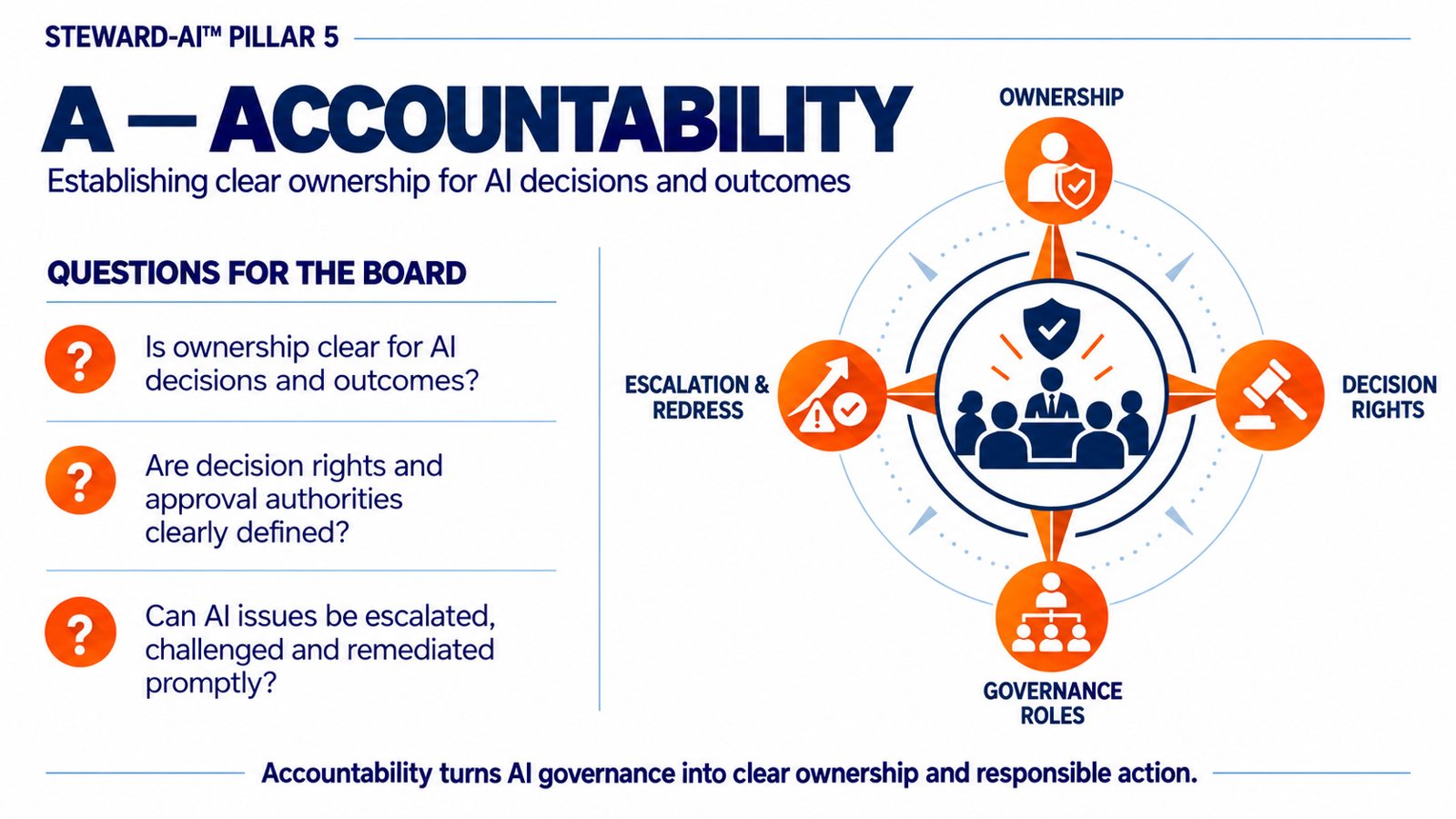
Accountability pillar of STEWARD-AI™: Ownership, Decision Rights, Governance Roles and Escalation and Redress.
Artificial intelligence can recommend, rank, predict and generate at a speed and scale that no individual can match. As these systems become embedded in customer interactions, employment decisions, financial services, operational processes and management reporting, they also distribute decision-making across data, models, vendors, business teams and automated workflows. When an outcome is wrong or harmful, responsibility can become difficult to locate.
For Boards, accountability begins with a direct question: who owns the decision and its consequences? The answer cannot be that the algorithm decided, the vendor supplied the model or the technology team implemented it. Management remains responsible for how AI is selected, used and monitored, while the Board remains responsible for effective oversight of material opportunities and risks.
This is the focus of the Accountability pillar within STEWARD-AI™, a Boardroom Framework for Responsible AI Leadership. The pillar translates governance commitments into named ownership, defined authority, clear organisational roles and workable mechanisms for challenge and remedy. It comprises four connected dimensions: Ownership, Decision Rights, Governance Roles, and Escalation and Redress.
Why Accountability Matters to the Board
AI rarely fits neatly within one function. A single use case may involve a business owner, technology team, data specialists, legal and compliance functions, risk management, internal audit and an external provider. Each may control part of the process, yet none may hold a complete view of the outcome. Without explicit accountability, important assumptions go unchallenged, risks fall between functions and corrective action is delayed.
Accountability connects authority with consequences. It clarifies who may approve an AI use case, who must monitor its performance, who can stop it and who must respond when people are affected. It also gives the Board a basis for constructive challenge. Directors can test whether management's governance arrangements are operating in practice rather than relying on policy statements alone.
1. Ownership
Every material AI system should have a named business owner who is responsible for its purpose, use and outcomes. Technical ownership is important, but it is not a substitute for business accountability. The accountable owner should understand the decision the system supports, the people it may affect, the performance expected of it and the controls needed throughout its lifecycle.
Ownership should remain clear when a model is supplied by a third party or embedded in a wider platform. Outsourcing technology does not outsource responsibility. Management should know who approves changes, reviews incidents and decides whether the system remains suitable as data, business conditions and regulatory expectations evolve.
Key Board question: Is ownership clear for AI decisions and outcomes?
2. Decision Rights
Clear decision rights specify who may propose, evaluate, approve, modify, pause and retire an AI system. They prevent two opposite failures: important decisions being made without sufficient authority, and low-risk experimentation being slowed by unnecessary approvals. The level of scrutiny should reflect the potential effect on customers, employees, markets and the organisation.
Boards should expect management to define approval thresholds for material use cases and preserve meaningful human authority where decisions carry serious consequences. Human oversight must be more than a nominal sign-off. The responsible person needs relevant information, adequate time, suitable competence and the practical power to question or override an AI-generated recommendation.
Key Board question: Are decision rights and approval authorities clearly defined?
3. Governance Roles
Effective accountability depends on roles that work together without creating gaps or duplication. The business should own the outcome. Technology and data teams should manage design, implementation and technical performance. Risk, legal, compliance and privacy functions should provide independent challenge within their mandates. Internal audit can assess whether the governance framework and controls operate as intended.
The Board should oversee this system of accountability rather than manage individual models. It should understand which committee receives material AI matters, how information reaches the Board and whether reporting distinguishes accountable ownership from advisory support. A responsibility map or similar governance record can make these relationships visible, particularly for AI systems that cross business units or jurisdictions.
Key Board question: Do governance roles provide clear ownership, effective challenge and appropriate Board oversight?
4. Escalation and Redress
Accountability becomes most visible when something goes wrong. Employees and control functions need clear routes to escalate unreliable, unfair or unexpected outcomes. Management should define the events that require escalation, the authority to suspend a system and the timetable for informing senior leadership, the Board, regulators or affected stakeholders where appropriate.
Redress concerns the organisation's response to people affected by an AI-enabled decision. They may need an understandable explanation, access to human review and a practical way to correct information or challenge an outcome. Complaints, overrides, incidents and near misses should also feed back into governance so that recurring weaknesses are identified and addressed.
Key Board question: Can AI issues be escalated, challenged and remediated promptly?
Turning Accountability into Boardroom Oversight
Accountability is distinct from, but connected to, the other STEWARD-AI pillars. Strategy establishes why the organisation is using AI. Trust considers whether stakeholders can have confidence in its use. Ethics examines whether outcomes are fair and consistent with human values. Workforce considers whether people and the organisation are ready. Accountability identifies who has the authority and obligation to act across all these areas.
The Accountability pillar encourages Boards to keep three questions at the centre of their oversight:
Is ownership clear for AI decisions and outcomes?
Are decision rights and approval authorities clearly defined?
Can AI issues be escalated, challenged and remediated promptly?
These questions move the discussion beyond policies and committee structures. They help Directors determine whether responsibility is visible, authority is matched with expertise and the organisation can respond when AI does not perform as intended.
Boards do not need to approve every AI application or examine every technical control. They do need assurance that material systems have accountable owners, defined decision rights, effective challenge and credible routes for escalation and redress. When these elements are in place, AI governance becomes capable of producing responsible action rather than remaining an expression of intent.
About the author: Dr. Rajiv Yadav is an international Board Strategy & Governance Advisor with more than 35 years of boardroom and executive leadership experience across Asia, Europe, the Americas and Australia in banking, financial services, infrastructure, insurance and technology. He is the creator of STEWARD-AI™.